Showing posts with label history. Show all posts

Tuesday, May 20, 2008

#208: Pioneers...

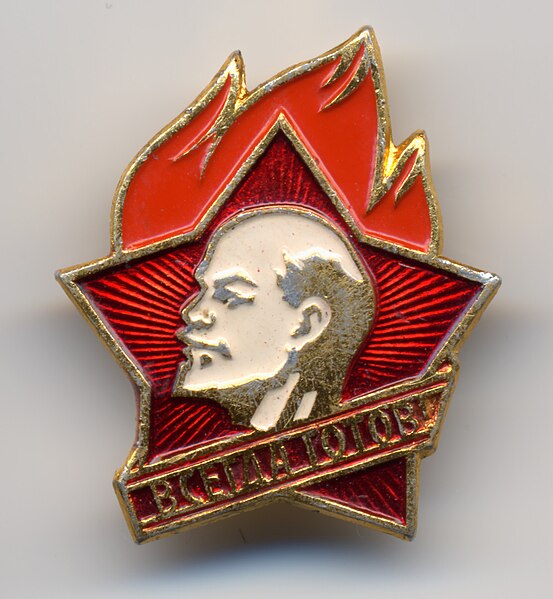
I would not have written about this if I had not seen the firework near a cafe in Bishkek and later, as I was driving by, a group of people in their 30s wearing red berets, red ties, and white shirts, and the Pioneer pins (below). It was apparently the 86th anniversary of the creation of the Pioneers, which represented the one of the stages (Oktyabrenok in 1-4th grades, Pioneer in 5-10th grades, and Komsomol in university) in becoming a member of the Communist Party in the USSR.
I remember myself when in 3rd grade the whole system disappeared along with the Soviet Union. That year I was really excited that I was moving up from Oktyabrenok to Pioneer. I was really sad that I did not get to become a Pioneer and never wore the red tie. Not that I regret it now, but a lot of people feel pride in those "good ole times" when everything was (seemed) good.

Monday, May 12, 2008

#206: Re-writing History

There are individual attempts to rewrite history of Kyrgyzstan, but these attempts are mostly unsuccessful mainly because of Russia's growing influence and revival of its might (both Tsarist and Soviet), while the Kyrgyz government is afraid to contradict the Big Brother (also in Orwellian meaning). The recent debate on marking of the 1916 revolt was muted, largely because of Russia's opposition to it.

Now, how do you rewrite the Basmachi revolts of early 20th century? Russian (Soviet) history clearly depicts them bandits (terrorists, kidnappers, killers) and opponents of the Communist dream. Meanwhile, the Kyrgyz are re-questioning this and re-thinking the history again as the grandsons of Janybek Kazy (Jani Begh in Pakistan) are returning to Kyrgyzstan with investment.

Janybek Kazy (circa. 1861-1933), originally from Özgön (Uzgen), was a nobleman who revolted against the Soviet collectivization and raskulachivanie policies in 1928. Under Russian punishment he fled first to China, then settled in Gilgit, Pakistan after the Soviet sent an army to arrest him. Some of his children in 1950's then migrated to Turkey. Currently, he as grandchildren living in Pakistan, Germany, Turkey, and Japan.

He and his followers were called basmachi for 70 years and the Soviet government told us they wanted to create an Islamic caliphate or a Pan-Turkist state (the current Russian government has pretty much follows the Soviet interpretation of history). With so little information from the archives of NKVD and KGB, the Kyrgyz are trying to re-write their own history. And once again, these attempts might fail due to the fear that Russian government might decide to deport all the Kyrgyz migrant workers (some 300,000 - 500,000people), most of them are illegally working there.

Monday, October 08, 2007

#115: The Turkestan Album

The Library of Congress scanned and posted on their website all the images from Turkestanskii Al'bom, which "provides a visual survey of Central Asia from the perspective of the Russian imperial government that took control of the area in the 1850s and 1860s. About 1,200 photographs, with some architectural plans, watercolor drawings, and maps, are arranged in four parts."

The collection includes pictures of historical sites, faces of Central Asian people living at that time, their clothes, traditions, holidays and celebrations, trades, maps (even the siege of Tashkent), and just everyday life. Since it presents things from Tsarist Russia's perspective, viewers should pay attention to the way pictures are taken (after all Russia was a colonizing power in a "backward region") and captions to them.

Another note. The Kazakhs in the pictures are described as "Kirgiz-Kazakhs," while the Kyrgyz are "Karakirgiz." Russians called the Kazakhs as Kyrgyz not to mistaken them for Cossacks, because words "Kazakh" and "Cossack" are pronounced very similarly in Russian, and the Kyrgyz became Karakirgiz, which means "Black Kyrgyz."

Here are some pictures of the Kyrgyz people from 1850s.

Jolbors (Yul Bars)
Dresses of Kyrgyz women

The Library of Congress did a truly great job. These pictures could help the Central Asians to learn more their history (and present). The Kyrgyz government could borrow, copy, or even bring this collection and organize a big exhibition.

Update: Russian version of the post is here.

Thursday, August 09, 2007

#83: On Afghanistan

Last night I went to sleep at around 5 am reading The Kite Runner, which I had for since last August, but never had the determination to start reading. I went to bed at around 11pm, but for some reason, despite my exhaustion, I could not fall asleep, so I took the book from shelve and started reading. Today, sleepy and tired at work, I realized that Afghanistan is of the main topics in the list of books, both fiction and non-fiction, that I've been reading lately. It all started with the The Great Game: The Struggle for Empire in Central Asia about a year ago.

No country in the world has experienced such a violent history with extreme changes as Afghanistan. Its people have suffered from British, Russian, and now U.S. interferences causing its government change from monarchy to communist rule to fanatic Taleban to the current tribal warlord rule.

These books below are fascinating sociologically and historically. The Soviet rule in 5 Central Asian republics cut off ties with Afghanistan and erased many cultural similarities between us. Some customs and believes, for example the hole concept of dignity, are still shared by many rural Kyrgyz (or other Central Asian people) and Afghans. Over the last 100 years we have drifted away: ex-Soviet Central Central towards Russia, while Afghanistan towards Pakistan, Iran, India. Once it was one cultural, religious, historical, political region.

1. Karl Meyer. Tournament of Shadows: The Great Game and the Race for Empire in Asia
2. Peter Hopkirk. The Great Game: The Struggle for Empire in Central Asia
3. Asne Seierstad. The Bookseller of Kabul,
4. Khaled Hosseini. The Kite Runner
Any other suggestions?
Wednesday, February 28, 2007

#41: Childhood items...

Items in this picture - from pins with young Lenin's picture to ninja or Rambo stickers - are all from my childhood. In late 80s and early 90s, when perestroika was going wrong and borders are opening, Kyrgyzstan, as other former Soviet republics, were being flooded with new Western things. Those were the days!!! I wonder if I have any these things lost in some warehouse or kladovka.